
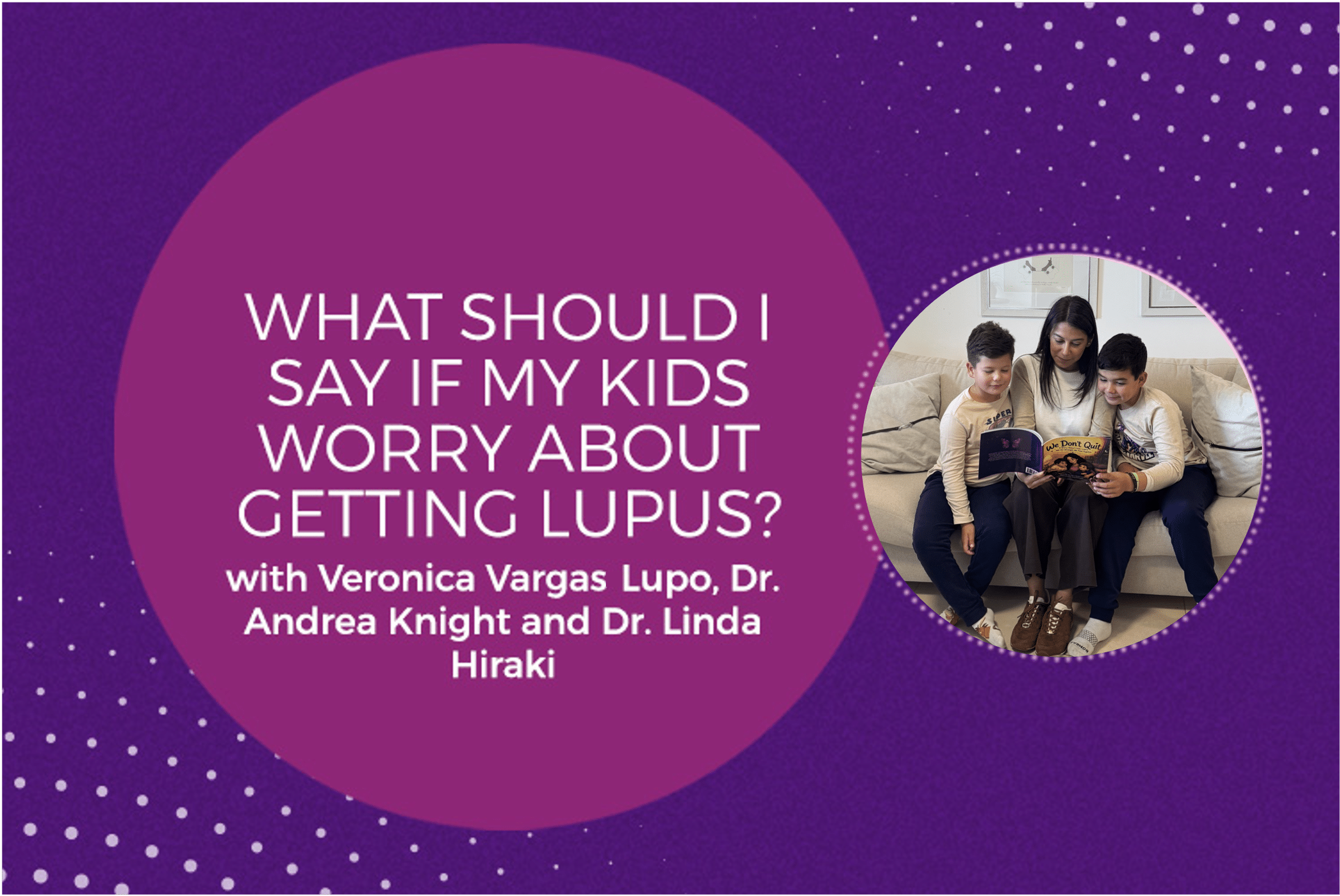
How to talk to your child about their risk of lupus
Many people living with lupus worry about how their disease affects the people they love the most. For parents, one of the hardest moments can come when a child asks a simple but deeply complicated question:
“Am I going to get lupus like you?
There is no script for how to respond — and no easy answer. It’s a moment where fear, love, and uncertainty collide.
Millions of adults around the world live with lupus – and many are raising children who worry about what the disease means for their family. For Veronica Vargas Lupo, a mother living with lupus, that worry surfaced one night at bedtime when her youngest son asked the question: “Mama, am I going to get lupus too?
For any parent, hearing those words can be heartbreaking. Fortunately, experts say there are ways to approach these conversations that are honest, age-appropriate, and reassuring.
Looking closer at the numbers
For parents concerned about “passing lupus down” to their children, it’s important to understand that lupus is not inherited in a simple, predictable way.
Pediatric lupus expert Linda Hiraki, MD, ScD, who studies lupus genetics at Toronto Hospital for Sick Children, explained that having a first-degree relative with lupus — including a parent — ncreases a person’s risk compared to the general population. However, that does not mean a child will definitely develop lupus.
There is also an important nuance behind the statistics. Lupus has often been called a “disease of a thousand faces” because symptoms and disease experiences vary widely from person to person. Even among family members who develop lupus, the disease may present very differently.
Dr. Hiraki also notes that children inherit only half of their genetic material from each parent, and genes alone do not determine whether someone will develop lupus.
For many families, understanding that higher risk does not equal certainty can help put fears into perspective.
One Parent’s Approach
When her son asked about getting lupus, Veronica chose not to avoid the conversation.
“The unknown is scarier than the known,” she said. “So, I answered with facts, reassuring him that his risk is low and that I work with the Lupus Research Alliance to support research that will help protect his future.”
Dr. Andrea Knight, MD, MSCE , a pediatric lupus expert at the Toronto Hospital for Sick Children and with a research focus on child mental health, supports that approach.
“It’s important to acknowledge a child’s fears while providing age-appropriate information,” she said. “Children are often looking for reassurance that they’re safe and that there are adults helping them navigate difficult situations.”
For Veronica, the conversation has never been a one-time discussion. As her children have grown, their questions — and her answers — have evolved. Wanting to create the resource she could not find to facilitate those conversations, she wrote We Don’t Quit: A Story About Love, Lupus, and the Strength We Find Together, a picture book available exclusively on Amazon in English and Spanish to help families talk about lupus in an honest, reassuring, and hopeful way.
“I wrote this book to help parents have a dialogue with their kids, allowing them to voice their feelings. Every child with a parent who has lupus deserves honest answers, gentle words, and reassurance,” she said.
Taking Back Control
One of the hardest parts of lupus for both parents and children is living with uncertainty. Dr. Knight and Dr. Hiraki say that many families find comfort in focusing on what they can control.
“I often discuss opportunities to participate in lupus research,” Dr. Knight said. “Many families feel empowered by taking action in a situation where they otherwise feel a lack of control.”
Veronica finds that sense of empowerment from serving in leadership roles with the Lupus Research Alliance Board of Directors and the Lupus Accelerating Breakthroughs Consortium (Lupus ABC), the first public-private partnership with the U.S. Food and Drug Administration that focuses specifically on advancing the development of safer and more effective treatments urgently needed for people with lupus.
Family risk is not just something Dr. Hiraki studies—it is something she understands personally. Her sister was diagnosed with lupus at an early age.
“I was a teenager when my sister was diagnosed with lupus, and it was scary for her and our whole family,” Dr. Hiraki recalled. “There was a sense of loss as we adjusted to what lupus meant for her life and our family. But watching my parents and her medical team respond with compassion and action made all the difference. It ultimately inspired my career in pediatric rheumatology and research.”
Her experience illustrates an important lesson: while families cannot control every outcome, they can control how they respond — with knowledge, support, and hope.
Ways to Keep the Conversation Going
When children ask about lupus, parents don’t need to have all the answers. Here’s what to focus on:
- Start by understanding what your child is worried about.
- Use age-appropriate language and honest answers.
- Explain that having a parent with lupus does not mean a child will develop the disease.
- Reassure children that they are not responsible for managing a parent’s illness.
- Keep the conversation open as questions change over time.
- Seek additional support if your child is struggling with fears or anxiety.
- Focus on hope and the progress being made through lupus research.
“For parents, these conversations may never feel easy. But children don’t need perfect answers,” Veronica said. “They need to know they can ask questions, share their worries, and face uncertainty with the support of the people who love them most.”
Tags: Dr. Andrea Knight, Dr. Linda Hiraki, Lupus ABC, Lupus Accelerating Breakthroughs Consortium, We Don't Quit: A Story About Love, and the Strength We Find Together, lupus, Veronica Vargas Lupo